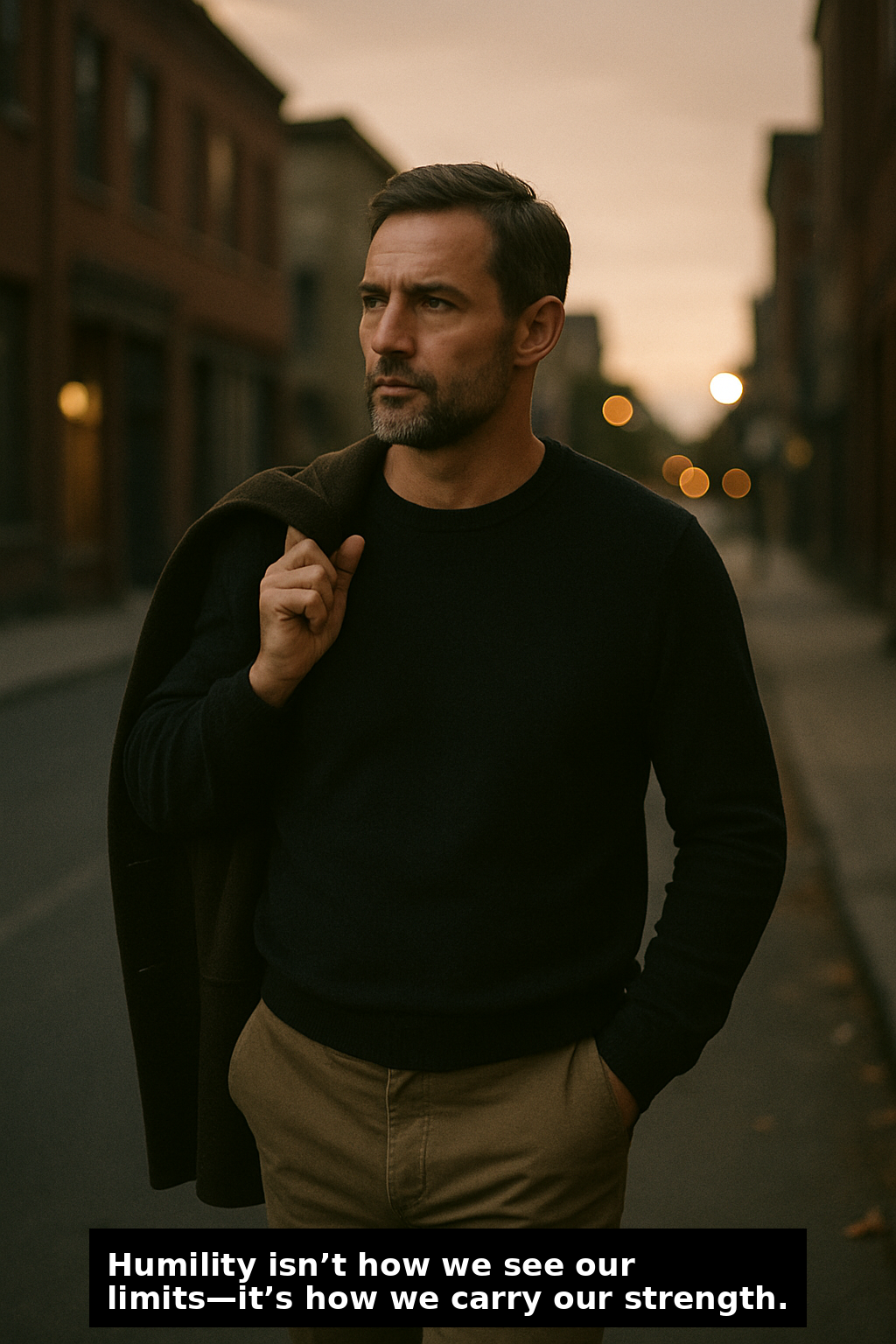
What if we’ve been defining humility wrong this whole time?
–––
Humility is one of those virtues everyone praises but few understand. We admire it. We aspire to it. But look closely and a contradiction appears.
We call someone humble when they downplay their talent or speak softly about their achievements. But we also call someone humble when they simply lack status or skill.
That’s the first mistake: we’ve confused humility with smallness.
The second mistake is subtler—and louder.
In some circles, humility is mocked as a loser’s virtue. Something the weak invoke to cope with irrelevance. After all, many of the world’s most successful people are not particularly humble. Some are blunt, bold, even arrogant—and still brilliant.
And that’s true. Humility is not required for success. You can be exceptional without it.
But that doesn’t mean humility is weakness. It means it’s not the only virtue. Among the many traits that can accompany greatness—discipline, vision, courage—humility is just one. Its absence doesn’t negate excellence. Its presence refines it.
“Humility isn’t how we see our limits—it’s how we carry our strength.”
The Misunderstanding of Humility
Culturally, humility has been flattened into a kind of performance. We think it means speaking quietly, avoiding credit, or acting uncertain about things we know.
But that’s not humility. That’s affectation. Or insecurity. Or a learned habit of self-minimization.
Real humility is invisible. It doesn’t draw attention to itself. It’s felt more than seen—a kind of internal discipline that doesn’t need external applause.
In today’s society, especially on social media, humility often goes unnoticed, undetected in the midst of so much noise and so much boasting. While we dismiss it at first hand as we are busy scrolling, we let algorithms feed our souls with lust at the expense of virtue.
We’ve romanticized the image of the quiet, unnoticed underdog and labeled it virtuous. But humility doesn’t come from lack. It comes from restraint.—the conscious choice not to display what could easily be flaunted.
Humility Is Not Mandatory
Let’s be clear: many successful people are not humble. And they don’t need to be. They lead, they execute, they dominate markets and ideas. Loudly. Confidently.
Does that make them flawed? No. It just makes them confident, assertive, perhaps egotistical—but not necessarily wrong.
Not all success comes from humility. And not all arrogance leads to downfall. Life is more complex than moral fables.
What humility offers isn’t a ticket to success. It’s a form of grace in how success is handled. A quiet strength that doesn’t demand recognition to be real.
Some people win through force. Others through precision. But those who carry their wins without needing to prove anything—they move differently. You can feel the depth. The clarity.
Redefining the Virtue
Let’s be rigorous here.
Humility isn’t thinking less of yourself. It’s thinking clearly of yourself—without distortion, without theater.
It is the restraint of justified pride.
Humility only exists when pride is possible. You can’t choose to be modest if you have nothing to be proud of. If you have no power, then restraint isn’t a virtue. It’s just limitation, and a limitation is not a virtue.
This is what Aristotle would call the golden mean. Virtue exists between extremes. Humility sits between arrogance and self-effacement. It’s the equilibrium point where truth is held without display.
So yes, you can be humble and say, “I did excellent work.”
You can be humble and own your authority, your value, your role.
Humility isn’t denial. It’s non-performance. You don’t need to downplay the truth. You just don’t need to parade it.
Humility and Strength Are Not Opposites
This is where the real misunderstanding lives. People assume you must choose: be strong or be humble.
But strength and humility are allies.
Strength is the capacity to act decisively. Humility is the choice not to inflate because of that strength.
It’s entirely possible to:
- Lead with conviction and stay grounded.
- Speak the truth without needing validation.
- Take credit when deserved, without clinging to praise.
A humble person can say “thank you” instead of “it was nothing.”
A humble leader can say “that was my decision” without arrogance.
The distinction is energy: pride demands attention. Humility doesn’t. It stands on clarity, not clamor.
Why This Virtue Still Matters
Even if humility isn’t required for success, it plays a critical role in self-mastery, leadership, and longevity.
It protects you from becoming a caricature of yourself.
It deepens trust with others, because it shows you don’t need to posture.
It enhances clarity. Because when you’re not trying to prove anything, you can focus on what actually matters.
Humility isn’t a posture. It’s a power.
You may not see it at work, but you can feel its presence—and that presence is its power.
Not all greatness is loud.
Some of it walks quietly, confident in its stride, unmoved by applause or doubt.
“Real strength walks in silence. Not because it must—but because it can.”
The Language Problem
Before we close, one final tension worth reflecting on—one that applies not just to humility, but to the way we define many virtues.
If we’re serious about redefining humility, we have to contend with the limits of our language. The dictionary definition of humility—“a modest view of one’s own importance”—echoes the confusion. It suggests a kind of self-downsizing, not the conscious restraint we’ve been exploring.
Part of the problem is poetic language. We say someone comes from “humble beginnings,” when what we really mean is “impoverished beginnings.” But we use a virtue-word—humble—to soften the story, to wrap poverty in unearned moral praise. It sounds better. So it spreads—until these poetic shortcuts become habitual, then institutional. They shape dictionary definitions. They shape how we think. Our language drifts away from precision and toward sentiment.
That’s how we end up praising poverty as if it were a virtue, or mistaking invisibility for character. It’s the poet’s trick of making something sound virtuous because it sounds beautiful.
Socrates was wary of poets for this very reason, he distrusted them—because when style overrides substance, truth erodes.
So if we want to reclaim humility as a real virtue, we may also need to reclaim our words.
So Where to From Here?
If this definition feels true, then deeper questions follow—questions not of theory, but of practice.
- How does one actually gain humility?
- Is it cultivated deliberately through introspection?
- Or earned unconsciously through hardship, failure, and time?
- What are the benefits and consequences of gaining a sense of humility at an early age, versus later in life?
Those are questions for another day. But worth sitting with.


Humility is a very difficult concept, because sometimes we act with humility, and other times we simply forget about it. We definitely need more humble people. Nowadays, many people don’t know what they don’t know, yet they still act as if they know everything.